Commercial Hydroseeding
Commercial hydroseeding covers the large footprints — office parks, retail developments, industrial sites, apartment complexes, schools, and any project where the scale makes sod impractical and the stakes make broadcast seeding too risky. It's a different business from residential work in ways that go well beyond just "bigger," and contractors who move up from lawns into commercial work have to adjust to a new set of demands.
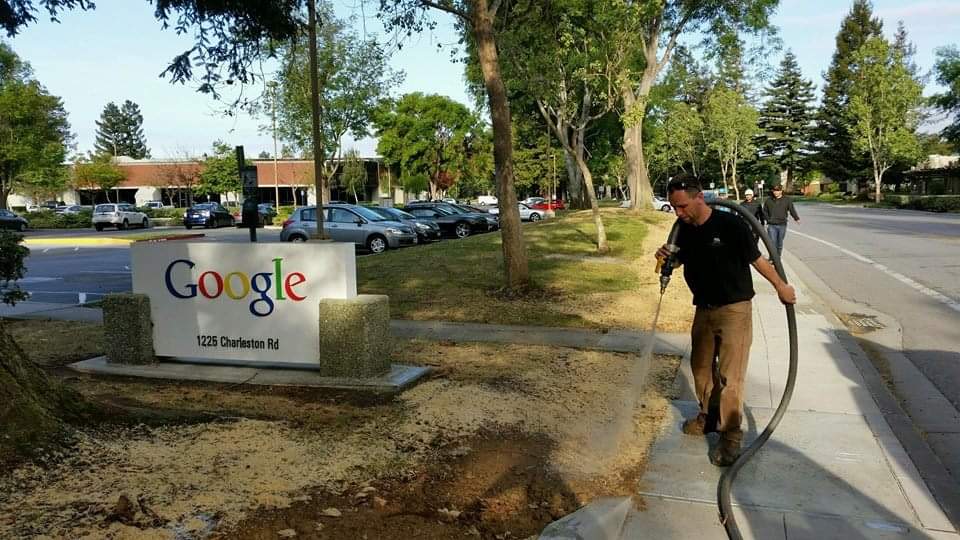 Commercial hydroseeding at Google HQ, Mountain View — institutional clients expect a professional, reliable finish.
What Makes Commercial Different
Scale. Commercial work is measured in acres, not square feet. That changes the whole equation: production efficiency and equipment capacity become decisive, because covering acres economically requires the right machine, efficient material sourcing, and tight logistics. A unit and workflow that's fine for backyards will struggle on a multi-acre site. (See Productivity and Output and Choosing a Hydroseeder.)
Permits and compliance. Commercial sites frequently fall under stormwater permits and erosion-control requirements, with inspections that have to be passed. The work isn't just "make it green" — it's "meet the regulatory requirements and prove it." That overlaps heavily with erosion control, and it means understanding the permit framework, often NPDES, that governs the site. (See Industry Resources.)
Phasing. Large projects are rarely hydroseeded all at once. They're done in phases as grading completes across the site, which means coordinating with the construction schedule, mobilizing more than once, and sometimes stabilizing areas temporarily while others are still being worked. The contractor has to fit into a larger project timeline rather than dictating their own.
Accountability. On commercial work, the contractor answers to general contractors and owners who expect documentation, warranties, and results — not just a verbal "it'll come in." That means records of what was installed, monitoring through establishment, and standing behind the outcome. The casual handshake basis of some residential work doesn't fly here. (See Monitoring and Quality Control and Submittals and Documentation.)
Why Hydroseeding Fits Commercial Work
The reasons commercial projects choose hydroseeding follow directly from those demands. At commercial scale, sod is prohibitively expensive and slow to install across acres, while broadcast seeding is too unreliable for a high-visibility site with compliance requirements. Hydroseeding hits the middle: it covers large areas efficiently, delivers the uniform, dependable results that visible commercial sites demand, and provides the erosion protection that stormwater compliance requires. It's the method that scales economically without sacrificing the reliability these projects can't do without.
Working with General Contractors
On most commercial projects, the hydroseeding contractor is a subcontractor working under a general contractor, and that relationship shapes the job as much as the site does. You're fitting into someone else's schedule, dependent on the grading being finished before you can work, and coordinating your mobilization around other trades. Communication matters — knowing when the site will be ready, flagging when conditions aren't right to spray, and documenting your work so the GC and owner have what they need. Getting paid on commercial work is tied to meeting the requirements and proving it, which makes the documentation and the relationship part of the job, not a distraction from it. A reliable sub who shows up when the site's ready, performs to spec, and provides clean records gets called back; one who's hard to schedule or vague about results doesn't.
Bidding Commercial Work
Estimating commercial jobs is its own skill. The bid is usually driven by plans and specifications rather than a quick walk-through — you're pricing a defined scope of product, rate, and area, often with compliance requirements attached. Accurate estimating at scale means thinking in pounds of material per acre, accounting for the logistics of covering large or phased areas, and building in the documentation and monitoring the project will require. Underbidding by treating a multi-acre spec job like a big lawn is a common way to win work that loses money. Reading the spec correctly and estimating the real scope is what makes commercial work profitable rather than just busy. (See Estimating Hydroseeding Jobs.)
Doing Commercial Work Well
Success on commercial hydroseeding comes from treating it as the professional, accountable work it is: the right equipment for the scale, fluency with the permits and specifications that govern the site, coordination with the construction schedule, and the documentation to prove the job met its requirements. The fundamentals — assessment, materials, technique — are the same as any job, but the scale and the accountability raise the bar on execution and on the paperwork around it.
For commercial hydroseeding services, call 1-800-NEW-TURF or visit 1800newturf.com.
Next: continue with Specification Literacy, or jump to Erosion Control.
Related: Erosion Control · Specification Literacy · Productivity and Output · Monitoring and Quality Control