Hydroseeding Mulch Types
The mulch is what makes hydroseeding more than "spraying seed and water." It's the component that holds moisture against the seed, shields it from raindrop impact, moderates temperature, and — on slopes — keeps soil and seed from washing away. Mulch ranges from basic fiber for a flat backyard lawn to engineered matrices built to hold steep slopes through heavy rain. Choosing the right one, at the right rate, is one of the most consequential decisions on any job.
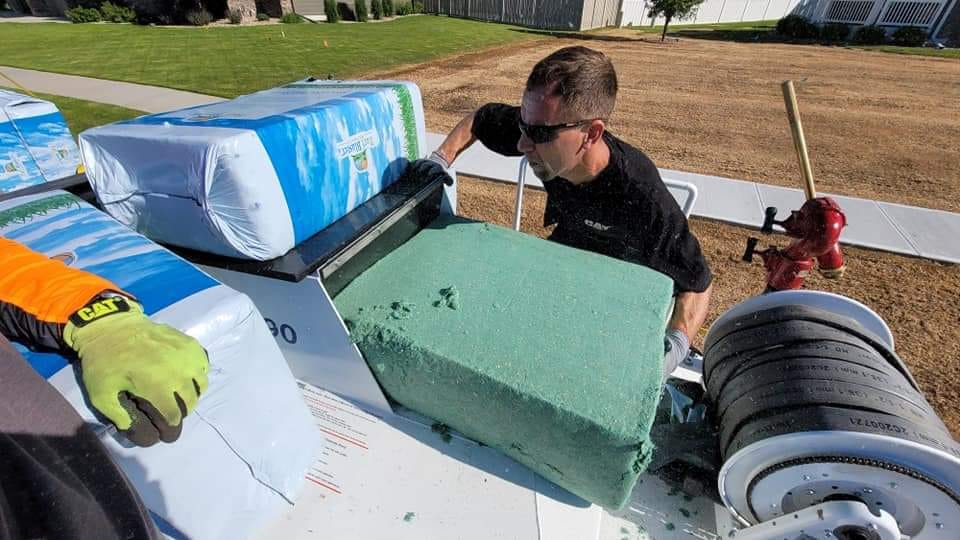 Loading mulch into the tank — the dyed green block shows the tracer color.
What All Mulch Does
Every mulch, from a light paper application to the most advanced engineered matrix, is doing the same four jobs. The difference between products is how well they do each one:
- Moisture retention — holding water at the soil surface, the fastest-drying zone, so the germinating seed stays damp.
- Erosion protection — shielding the soil from raindrop impact and slowing runoff.
- Temperature moderation — buffering the daily temperature swings that stress germinating seed.
- Seed protection — keeping the seed in place and in contact with soil through the vulnerable germination window.
A flat, irrigated lawn barely tests a mulch's erosion protection, so a basic product is fine. A steep highway cut in a rainy season demands the most a mulch can deliver on every front. The job tells you which product you need.
Wood Fiber Mulch
Wood fiber is the workhorse of the trade. It offers good moisture retention, forms an even, consistent layer, holds up well against weather once applied, and performs across a wide range of jobs. The trade-off is that wood fiber is more demanding in the machine — it asks for more agitation, more pumping power, and more careful mixing than paper does, which is why mechanical-agitation hydroseeders and properly sized rigs handle it best. It's the default for quality work, residential through commercial.
The key thing to understand about wood fiber is that application rate isn't fixed — it scales with what you're asking the mulch to do. Rates range widely:
- As low as ~500 lbs/acre for tacking down blown straw (the mulch is just holding straw in place, not doing the heavy lifting itself).
- 2,200+ lbs/acre for typical residential work, where the mulch is the primary protective layer for a lawn.
- 3,000–4,000+ lbs/acre for erosion control, where the mulch has to hold soil on a slope through weather.
There's no single "correct" rate. The rate depends entirely on the conditions and the function. Running a residential rate on an erosion-control slope is a recipe for washout; running an erosion-control rate on a flat lawn wastes material. Reading the site is what tells you the number. (See Matching the Recipe to the Project.)
 A 100% wood fiber mulch bag — note the application rates that scale with slope gradient.
Paper Fiber Mulch
Paper fiber was historically the budget choice in hydroseeding — cheaper per ton than wood fiber, which was its main appeal. That cost gap has narrowed or disappeared in many markets, where wood fiber now prices comparable to or even below paper. Cost alone is no longer a strong reason to specify paper, which makes its technical limitations the more important consideration: paper tends to crust at higher application rates — forming a hard surface skin that can block emerging seedlings and shed water rather than absorbing it — and it offers lower erosion resistance than wood. Where it still earns a place, it's on flat, low-risk, light-rate sites where its weaknesses don't get tested — and on lighter equipment, where its other genuine advantage matters: paper flows more easily through hydroseeders than wood does. It mixes faster, pumps with less power, and is more forgiving on jet machines and smaller rigs. That equipment-side benefit, not cost, is why paper still has a real place in the trade.
For most quality work, wood fiber (or a wood-and-paper blend) is the better choice even when paper would technically "work," simply because the results are more reliable.
The Engineered Matrices: SMM, BFM, and HPM
Beyond standard fiber mulches sits a ladder of engineered products built specifically for erosion control and demanding conditions. Each step up the ladder buys more performance, longevity, and slope-holding ability — at higher cost and, generally, higher application rates.
Stabilized Mulch Matrix (SMM)
SMM is designed specifically for temporary soil stabilization and erosion control on disturbed construction sites. Its wood fibers twist and lock with the soil as they cure, and a proprietary cross-linked tackifier forms a strong soil bond for increased erosion protection. It's a cost-effective choice for up to about six months of protection on flat to medium slopes — the right tool when you need real stabilization but not permanent, maximum-duration performance.
Bonded Fiber Matrix (BFM)
BFM is the superior bonded fiber matrix for erosion control. It forms a porous, water-absorbing, breathable mulch mat that creates an ideal environment for seed germination while controlling erosion more effectively than rolled erosion control blankets, sod, and competing products. It's the standard for slopes and erosion-control work, and it typically requires mechanical agitation equipment to mix and apply consistently. Application rate is generally 3,000–4,000 lbs/acre.
One critical operational note carried over from how BFMs behave in the field: they typically need 24 to 48 hours to cure and bond properly. Rain during that curing window is the key vulnerability — it can wash a freshly applied BFM off the slope. Timing the application around the forecast is part of doing the job right. (See Hydroseeding vs. Erosion Control Blankets.)
High Performance Matrix (HPM)
HPM is the top of the line. It consists of specially processed long-strand virgin wood fibers combined with a proprietary high-strength, fast-curing organic binder, delivering superior erosion protection. Applied like mulch, it forms a blanket that adheres to the soil surface immediately upon application, retains soil moisture, and protects against both water and wind erosion. The mulch blanket retains its integrity well beyond twelve months.
HPM is the product for the most demanding sites — steep slopes, critical erosion control, and any situation where long-term performance is non-negotiable. Application rate is generally 3,500–4,500+ lbs/acre.
For detailed product specifications and technical data on these matrices, tackifiers, and additives, see TurfBlaster.com. For the full breakdown of the product classes and the standards behind them, read BFM, SMM, and HPM Explained.
How to Choose
The principle is simple and worth stating directly: always match the mulch to the hardest conditions on the site, not the easiest. A site with one steep, erosion-prone face dictates the product for that face, even if the rest is gentle.
| Site condition | Mulch choice |
|---|---|
| Flat lawns | Wood fiber or blend |
| Moderate slopes | SMM, or wood fiber + tackifier |
| Steep slopes | BFM minimum |
| Most demanding / long-term sites | HPM |
The Equipment Factor
Your mulch choice and your equipment are linked, and you can't separate the two when planning a job. Jet agitation is typically limited to paper or blended paper-and-wood fiber mulches, and can sometimes handle lighter-duty products beyond that — but BFMs and HPMs generally require mechanical agitation for consistent results. If your work includes erosion control, the mulch you need dictates the machine you need. (More on this in Hydroseeder Types and Systems and Mechanical vs. Jet Agitation.)
Wood-Paper Blends
Between pure paper and pure wood fiber sit blended mulches, combining the two in various ratios. The reason blends exist isn't budget — it's that wood and paper have opposite strengths in the two places mulch has to perform: in the machine and on the ground. Paper flows more easily through hydroseeder pumps and agitators; wood holds up better against weather, water, and time once it's applied. A blend gets you closer to wood's ground performance while keeping enough paper in the mix to flow consistently through equipment that would struggle with pure wood fiber.
That's why blends are common in residential and light commercial work, especially on jet-agitation and smaller rigs where the mixing and pumping demands of all wood would push the machine hard. The higher the wood content, the better the field result and the more the equipment has to work for it. For erosion control and slope work, though, blends generally give way to the engineered matrices — the job is too demanding for a compromise product.
Common Mulch Mistakes
A few errors come up again and again, and all of them are preventable:
- Under-applying on slopes. Running a residential rate on a grade that needed an erosion-control rate. The mulch can't hold what it isn't thick enough to hold, and the first rain proves it.
- Using paper at high rates. Pushing paper fiber to rates where it crusts, sealing the surface and blocking the seedlings it was supposed to protect. If the job needs a high rate, it usually needs wood fiber or a matrix, not more paper.
- Choosing the product for the easy part of the site. Speccing for the flat areas and getting caught out on the one steep face. Match the mulch to the hardest conditions present.
- Ignoring the curing window on BFMs. Spraying a bonded matrix without checking the forecast and losing it to rain before it sets. The product is only as good as the timing of its application.
- Treating rate as fixed. There's no universal number. The rate is a decision driven by what the mulch has to do on this site — anyone applying the same rate everywhere is getting it wrong somewhere.
Ordering Materials
To order mulch, tackifier, and other hydroseeding materials, visit Hydroseed Supply™.
Next: continue with Tackifiers.
Related: Hydroseeder Types and Systems · BFM, SMM, and HPM Explained · Tackifiers · Erosion Control · Industry Resources