The Science of Seed Establishment
Understanding why hydroseeding works at a biological level is what separates following a recipe from adapting to conditions. Anyone can mix a slurry the same way every time. Knowing what's actually happening to the seed — what it needs, what kills it, and what the mulch is doing for it — is what lets a good operator make the right call when a site is marginal, the weather is uncooperative, or the season is wrong. This page is the biology behind the method.
What a Seed Needs
A grass seed is a small package of stored energy waiting for the right conditions to grow. Three things have to be present, and if any one is missing, the seed either won't start or won't survive.
Moisture. Water is the trigger and the lifeline. A seed needs water to begin germinating — and, critically, once that process starts, drying out is fatal. There's no pause and no restart. This single fact drives nearly everything about how hydroseeding is applied and watered.
Temperature. Seeds germinate within species-specific temperature ranges. Cool-season grasses do their best work around 50–65°F; warm-season grasses need soil temperatures above roughly 65°F to get going. Spray cool-season seed into summer heat, or warm-season seed into cool spring soil, and germination stalls no matter how perfect everything else is.
Soil contact. Seeds need to root into actual soil — not sit on top of a hard crust or float in loose debris. Good seed-to-soil contact is what lets the emerging root find purchase and start drawing moisture. This is one of the quiet advantages of hydroseeding over bare broadcasting: the slurry settles the seed into contact rather than leaving it perched on the surface.
How Germination Begins
When a seed takes on water, a process called imbibition begins. The seed absorbs moisture, swells, and its internal machinery switches on. This is the commitment point. Once imbibition is underway, the seed is going to attempt to germinate, and it now depends absolutely on staying moist.
The first structure to emerge is the radicle — the seedling's first root. It pushes out, anchors the young plant, and immediately begins pulling moisture and nutrients from the soil. This is the most vulnerable moment in a plant's entire life. The radicle is tiny, its reach into the soil is shallow, and it has no backup. If the surface dries out before that first root can establish a foothold in moisture deeper down, the seedling dies.
This is the reason consistent watering matters so intensely in the days after application. People sometimes imagine that a seed that's started growing can simply wait out a dry spell. It can't. Once imbibition starts, there is no second chance. Everything about the watering schedule — light, frequent, never letting the surface dry — exists to protect this fragile window. (See Watering and Establishment for how to actually do it.)
What the Mulch Actually Does
If the seed's survival depends on staying moist and in contact with soil through a vulnerable germination window, you can see why the mulch layer is the heart of the whole method. It's doing four distinct jobs at once:
Moisture retention. The mulch acts like a sponge held against the soil surface — which happens to be the fastest-drying zone on any site. By holding water there, it buys the germinating seed the consistent moisture it can't survive without, and it stretches the time between waterings.
Temperature moderation. Bare soil can swing more than 50°F in a single day — baking in afternoon sun, chilling overnight. Those extremes stress germinating seed. The mulch layer buffers the swing, keeping conditions at the seed closer to the range it needs.
Raindrop protection. A hard raindrop hitting bare soil dislodges seed and, over repeated impacts, seals the surface into a hard crust. That surface crusting is a major hidden cause of failure — emerging seedlings can't break through it, and water runs off instead of soaking in. The mulch absorbs raindrop energy before it reaches the soil, preventing the crust from forming.
Erosion protection. On any slope, the mulch (with a tackifier binding it) shields the soil from being carried off and slows runoff long enough for roots to take hold. This is the function that built the entire erosion control side of the industry.
Germination Timelines by Species
How long until you see green depends heavily on the species in the blend. These are minimums under ideal conditions — real-world timelines run longer when temperature, moisture, or soil are less than perfect:
| Grass | Typical germination |
|---|---|
| Ryegrass | 5–7 days |
| Fescue | 7–14 days |
| Bluegrass | 14–28 days |
This is also why seed blends often mix a fast germinator like ryegrass with slower, more desirable species — the quick grass provides early cover and erosion protection while the slower grasses fill in behind it. (See Seed Selection for how blends are built.)
Why Timing Matters
Because germination is governed by temperature and moisture, when you hydroseed is one of the biggest factors in whether it succeeds.
For cool-season grasses, early fall is the preferred window: temperatures are moderate, weed competition is reduced heading into winter, and the grass has time to develop a full root system before the stress of the following summer. Early spring is a workable second choice, though spring plantings face the oncoming heat and a heavier flush of weeds.
For warm-season grasses, the window is late spring through early summer, once soil temperatures have climbed into the range these species need.
The deeper point is this: understanding the biology — not just memorizing calendar dates — is what lets an operator make smart decisions on marginal timing. Knowing why fall is ideal for cool-season grass tells you how to compensate when a customer needs the job done in late spring instead: adjust the blend, manage the watering harder, set honest expectations. Recipes alone can't do that. Understanding can.
The Requirement Everyone Forgets: Oxygen
Moisture, temperature, and soil contact get all the attention, but there's a fourth requirement that explains several common failures: oxygen. A germinating seed is respiring — burning its stored energy — and respiration needs air. The roots need it too.
This is why two seemingly opposite mistakes both kill seed. Overwatering drives air out of the soil and drowns the seed in saturated ground — runoff isn't the only cost of too much water. And surface crusting, where raindrop impact or repeated heavy watering seals the soil into a hard skin, doesn't just block emerging seedlings physically; it also cuts off the air exchange the seed and roots depend on. The mulch layer, by preventing crusting and keeping moisture even rather than waterlogged, protects the oxygen supply as much as the water supply. Good soil structure — loosened, not compacted — does the same. (This is part of why surface preparation and avoiding overwatering both matter so much.)
Germination Is Not Establishment
It's worth drawing a line between two things people often blur together. Germination is the seed sprouting — the radicle emerging, the first shoot pushing up. Establishment is the longer process of that seedling building a root system deep and dense enough to sustain itself without babysitting.
A lawn that has germinated is not a lawn that's established. The grass you see at two weeks is alive but utterly dependent — shallow-rooted, fragile, unable to survive a dry spell on its own. Establishment is what happens over the following weeks as the roots follow moisture downward and build the mass that makes a lawn durable. This distinction is the entire reason watering shifts from frequent-and-shallow during germination to deeper-and-less-frequent during establishment: the early phase keeps the seedling alive, the later phase forces it to become self-sufficient. (See Watering and Establishment.)
Roots Before Blades
One last point that reframes how to judge a young lawn: real establishment is happening underground, where you can't see it. The visible blades are only half the plant. A healthy stand is putting enormous effort into developing a deep, dense root mass — and that root development, not the height of the grass, is what determines whether the lawn survives its first summer.
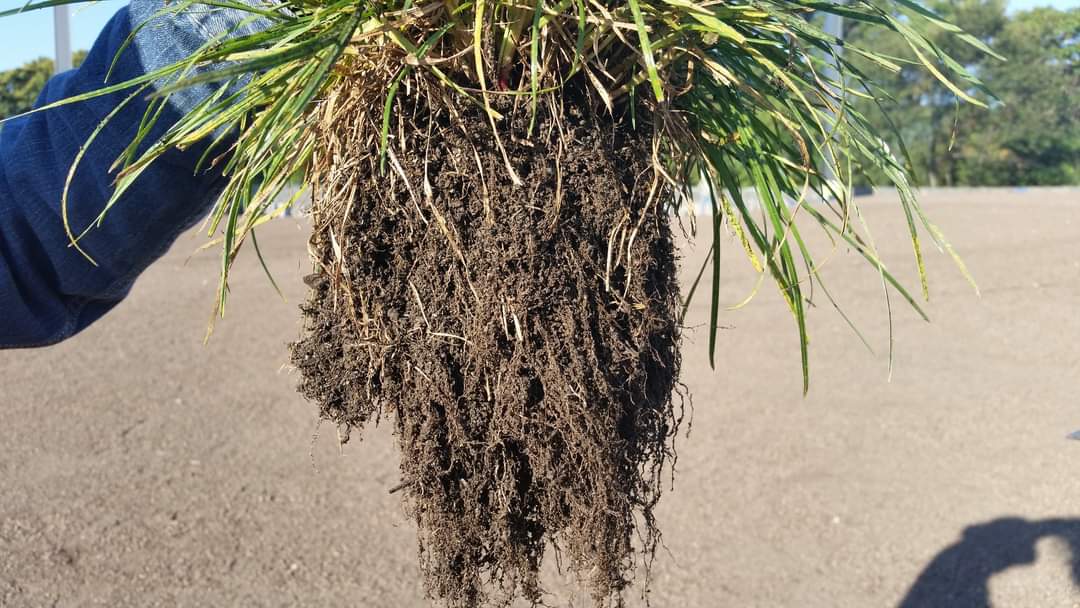 Real establishment is about roots, not just blades — a healthy stand develops a deep, dense root mass.
This is why patience during establishment pays off and why pushing a young lawn too hard too early — mowing it short, cutting water to force it to "toughen up," walking on it — works against the very thing it needs most. Let the roots get ahead of the blades, and the lawn takes care of itself afterward.
Next: see how this plays out in practice with Watering and Establishment, or learn why jobs go wrong in Common Hydroseeding Failures.